
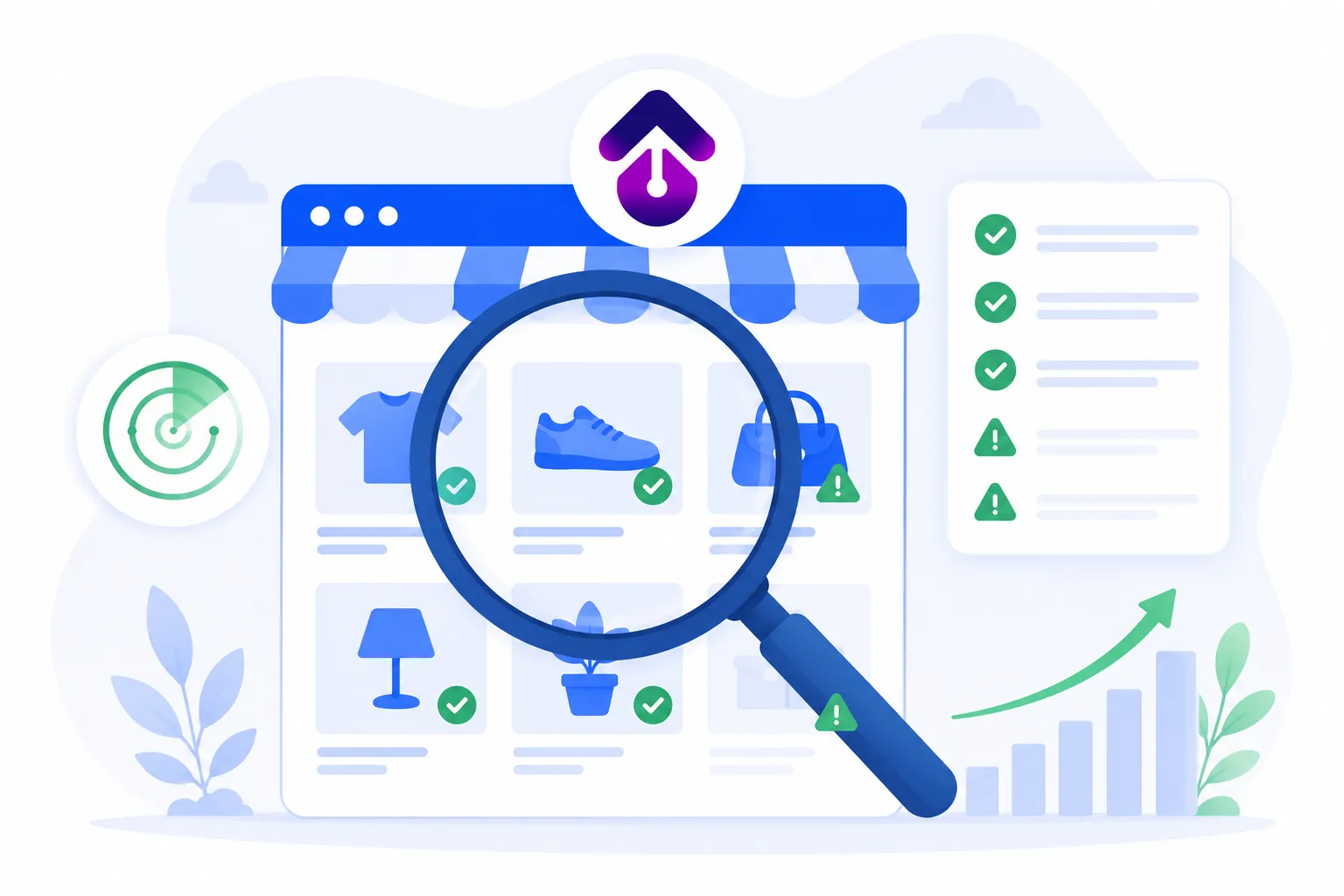
An ecommerce SEO audit is a systematic check of your online store for technical SEO issues, thin product copy, duplicate content and crawl problems. This guide contains the complete checklist with over 30 checkpoints, what an audit costs in time and money, and the order in which to fix what you find. SEOptimate maps these points automatically and shows per page what to improve for more organic traffic.
Want to see where your store is losing traffic right now? Request the free SEO scan: we walk through your store live and you get the key findings straight away.
What is an ecommerce SEO audit?
An ecommerce SEO audit is a focused review of your online store that assesses technical SEO, content and user experience for issues that hold back your visibility and revenue. The difference with a regular website audit is scale and complexity: a store has hundreds or thousands of pages, filtered categories and product variants, each with their own SEO risks.
Where a blog or company site mostly runs on content and authority, a store also runs on product data, stock pages and filter combinations. Those last ones frequently cause duplicate content and wasted crawl budget. A good ecommerce audit therefore looks specifically at these pitfalls. For the general approach, see the guide on how to run a website audit.
Why an audit matters for your visibility
A store only attracts customers when its product pages can be found in Google. Many stores invest in ads while their organic visibility is held back by technical problems an audit surfaces easily. The most common ones: filtered category pages without canonical tags, product pages with copied supplier text, and category pages without any descriptive content. Each of these is a fix that improves your organic positions without spending a euro on ads.
The five areas of a complete audit
- Technical health: status codes, load time, mobile rendering and HTTPS.
- Indexing and crawling: which pages are in Google and which are blocked by accident.
- Duplicate content: filtered URLs and copied product copy competing with each other.
- On-page elements: title tags, meta descriptions and heading structure per category and product.
- Product data: unique copy, alt texts and Product schema per product page.
The complete ecommerce SEO audit checklist
Work through the five areas below point by point. Each item is a concrete check with a clear outcome: fine, or action needed.
1. Technical health
- HTTPS active on all pages, without mixed-content warnings.
- No broken pages: check your key categories and products for 404s.
- No redirect chains: old product URLs point to their destination in a single hop.
- Load time under 2.5 seconds on mobile; test your busiest category page in PageSpeed Insights.
- Mobile rendering works: filters, menu and the buy button function on a phone.
- XML sitemap is current, contains only indexable URLs and is submitted in Search Console.
- robots.txt does not block categories or products you want to rank.
2. Indexing and crawling
- The number of indexed pages in Search Console is in line with your sitemap; large gaps signal a problem.
- Filter and sort URLs are not in the index; verify with a spot check in Google.
- Every paginated category page has a correct canonical.
- No accidental noindex tags on pages that should rank.
- Internal search result pages are set to noindex.
- Crawl stats in Search Console show no spikes on worthless URLs.
3. Duplicate content
- Product copy is unique and not taken from the supplier; that text lives on dozens of other stores.
- Filter variants of category pages point to the main category via canonicals.
- Product variants (colour, size) have one main page instead of separate indexable URLs per variant.
- Your store is reachable through one host variant; www and non-www resolve to the same canonical version.
- Category copy is not duplicated across similar categories.
4. On-page elements
- Every category and product has a unique title tag with its main keyword.
- Meta descriptions are written to earn the click, not auto-generated from the product description.
- One H1 per page that clearly states the topic.
- Category pages have their own introduction of at least a few paragraphs.
- Key categories are reachable within three clicks from the homepage.
- Breadcrumbs are present on all category and product pages, including BreadcrumbList schema.
- Internal links point from blog content to the relevant categories, not only the other way around.
5. Product data and conversion
- Product schema present with price, availability and ratings, without errors in the Rich Results Test.
- Product images are compressed and have descriptive alt texts.
- Sold-out products do not end in a bare 404: show alternatives or redirect to the category.
- Reviews or ratings are visible on the product page.
- Prices and stock in the structured data match what the visitor sees.
- Product copy answers the questions buyers actually ask, instead of only listing specifications.
What does an audit cost in time and money?
A one-off agency audit quickly runs into hundreds to thousands of euros, and an ongoing agency engagement starts around €1,000 per month. Auditing manually is free but takes days for an average store, and half your findings are outdated three months later.
The practical middle road is tooling that automates the check and keeps repeating it. SEOptimate scans your store continuously from €129 per month and turns the findings into a prioritised action list. The first insight comes sooner: in a free thirty-minute demo we walk through your store live and you see the biggest opportunities immediately.
How to fix what you find
Prioritise by impact, not by order of discovery. Indexing blockers always come first: a perfect product page that is not in Google earns nothing. Then duplicate content and the on-page elements of your busiest categories, and only then the details per product. Selling on Shopify, Lightspeed or Magento? See the platform guides for Shopify SEO, Lightspeed SEO and Magento SEO, or the broader ecommerce SEO guide.
How often should you audit?
Run a full audit at least twice a year and a quick check every quarter. A store changes constantly: new products, sold-out items, price changes and seasonal collections, and every change can introduce new technical problems. Always audit after a big change such as a platform migration, a restructured category tree or a Google update.
An ecommerce SEO audit is the foundation for structurally more organic traffic to your store. Request the free scan and discover the opportunities for your store today.
Wondering what fixing all of this costs? Read what SEO costs: agency, software and DIY compared honestly.
A systematic check of your online store for technical SEO issues, thin product copy, duplicate content and crawl problems. You review category pages, product pages and filters for indexability and search value to find where you are losing traffic and revenue.
A one-off agency audit costs hundreds to thousands of euros and an ongoing agency engagement starts around €1,000 per month. With a tool like SEOptimate you automate the audit from €129 per month, and a first walkthrough of your store is free in the demo.
Set canonical tags that point to the main category, use noindex on filter combinations without search value, and rewrite supplier text on your most important products. SEOptimate detects automatically which pages contain duplicate content and which canonicals are missing.
Yes. With the checklist in this guide and the right tooling an audit is very doable yourself. SEOptimate scans your store automatically and returns a prioritised action list, so you do not have to walk through hundreds of pages by hand.

About the author
Koen Pijnenburg
Founder & CEO, SEOptimate
Koen Pijnenburg is the founder and CEO of SEOptimate. As an entrepreneur with years of experience in e-commerce and online marketing, he helps businesses grow their organic traffic through AI-powered content automation.
LinkedIn →