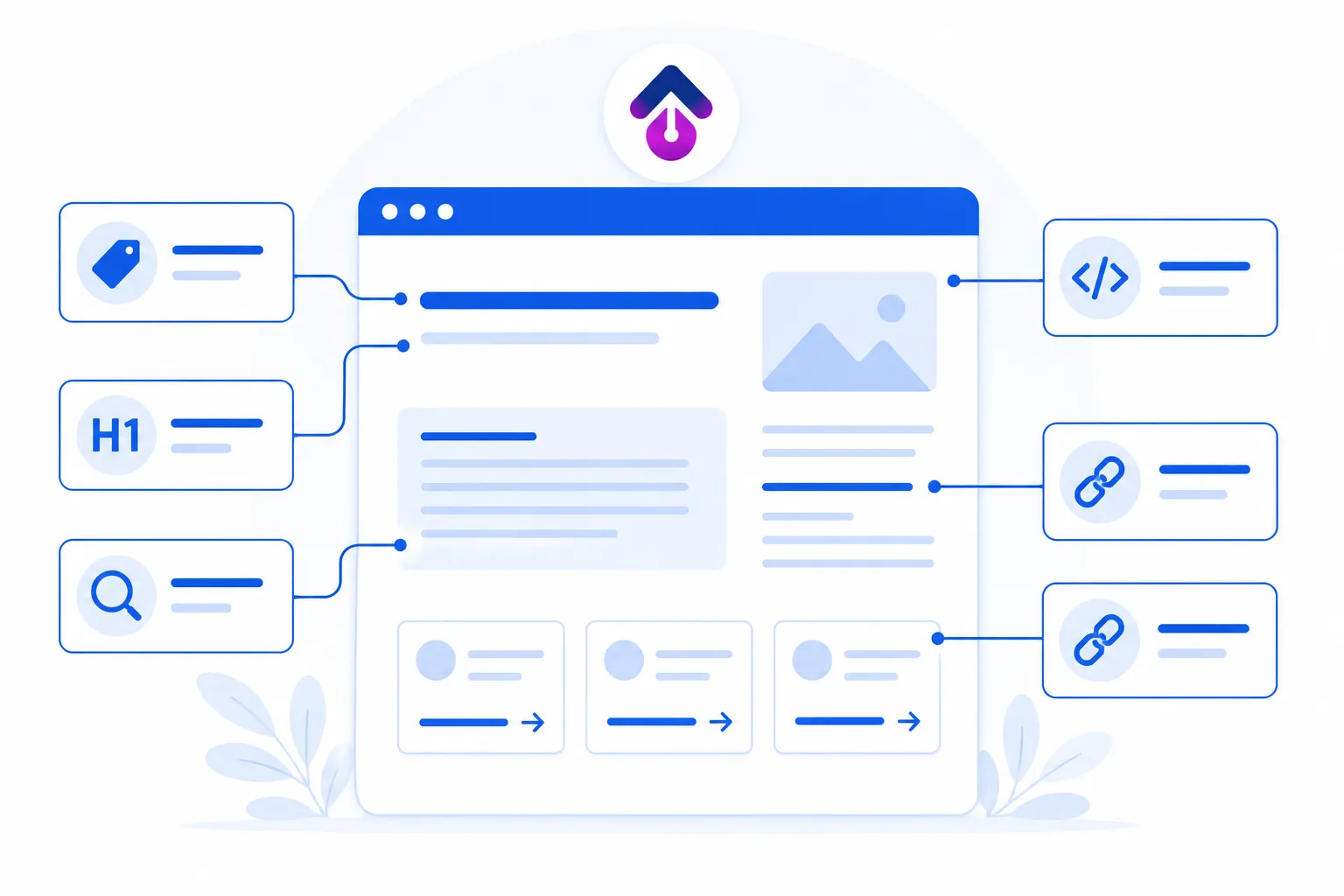
On-page SEO covers every optimisation you make directly on a web page: the title tag, meta description, heading structure, content quality and internal links. It is the foundation of every SEO strategy and the only part you fully control. This guide walks through each element and how to optimise it.
On-page SEO is the basis of every successful search strategy. Yet many websites leave opportunities on the table by focusing on link building and technical work while forgetting the page itself. Want to understand the bigger picture first? Read how search engine optimisation for Google works across its three pillars.
What is on-page SEO?
On-page SEO is every optimisation you perform directly on a web page: the copy, the structure, the HTML and the user experience. It differs from off-page SEO (such as backlinks) and technical SEO (such as load speed and crawlability). The three work together, but on-page is the starting point: without it, the rest achieves little.
How do you optimise a title tag?
The title tag is the most influential on-page element. It is the clickable text in the search results and tells Google and the user immediately what the page is about.
- Use your main keyword as early in the title as possible.
- Keep the length between 50 and 60 characters so Google does not truncate it.
- Make the title unique for every page.
- Write for the user: a good title invites the click.
- Add a year or number when relevant.
Use the free SEO tools from SEOptimate to check and generate your title tags quickly.
How do you write a good meta description?
The meta description appears below the title tag in the search results. Google does not use it as a direct ranking factor, but it does drive your click-through rate (CTR), and a higher CTR is in turn a positive signal for Google.
- Maximum 155 characters, or it gets truncated.
- Use the main keyword; Google bolds it in the results.
- Add a call to action such as "Read more" or "See the checklist".
- Write a unique description for every page.
How do you use headings for SEO?
Use one H1 per page containing your main keyword, then structure the content with H2 and H3 headings. Phrase H2 headings as questions that match what people literally search for. Google's AI Overviews and tools like ChatGPT and Perplexity prefer to extract answers from question-driven sections.
How do you write content that ranks?
Google judges content on experience, expertise, authority and trust (E-E-A-T). But before you can work on quality, you need to understand search intent. There are four types: informational, navigational, commercial and transactional. Match the form and depth of your content to the intent behind the keyword.
Add a quick-answer block of 40 to 60 words at the top of every page that answers the main question directly. This is what Google AI Overviews and AI search engines use for citations.
Why do internal links matter for SEO?
Internal links connect the pages on your website. They help Google understand your structure and spread authority across your pages. Link from strong pages to pages you want to lift, and use descriptive anchor texts. A common mistake is keyword cannibalisation: two pages competing for the same keyword. Give every page one unique primary keyword.
How do you optimise images for SEO?
Give every image a descriptive alt text with the relevant keyword and use a descriptive file name. Compress images for faster loading and prefer the WebP format; page speed counts as a ranking factor.
What does a good URL structure look like?
A good URL is short, descriptive and contains the main keyword. Use hyphens between words, not underscores, and avoid long URLs with numbers or parameters.
Good: seoptimate.com/blog/on-page-seo-complete-guide
Not good: seoptimate.com/?p=1234&category=seo
Improve your on-page SEO automatically with SEOptimate
Start with a website audit to identify the biggest issues. SEOptimate then analyses your pages automatically on every on-page element and returns concrete improvements: which title tags run too long, which pages miss a meta description and which content does not match the search intent. Book a free demo and see how many on-page opportunities your website still has.
On-page SEO is about the content and structure of individual pages: copy, headings, title tags and internal links. Technical SEO is about the technical base of the whole website: load speed, crawlability, HTTPS and sitemaps. You need both, but on-page SEO is the starting point.
On average you see the first movement in Google within 4 to 12 weeks after an optimisation. Existing pages that are already indexed respond faster than brand-new content.
No, Google does not use the meta description as a direct ranking factor. But a good meta description raises your click-through rate, and a higher CTR is a positive signal for Google.
There is no fixed number. Use the keyword naturally in the H1, the first paragraph and throughout the text. Always prioritise readability over repetition.
Keyword cannibalisation happens when two or more pages compete for the same keyword. Google splits the authority between them and neither ranks well. Prevent it by giving every page a unique primary keyword and auditing your website regularly.

About the author
Koen Pijnenburg
Founder & CEO, SEOptimate
Koen Pijnenburg is the founder and CEO of SEOptimate. As an entrepreneur with years of experience in e-commerce and online marketing, he helps businesses grow their organic traffic through AI-powered content automation.
LinkedIn →