
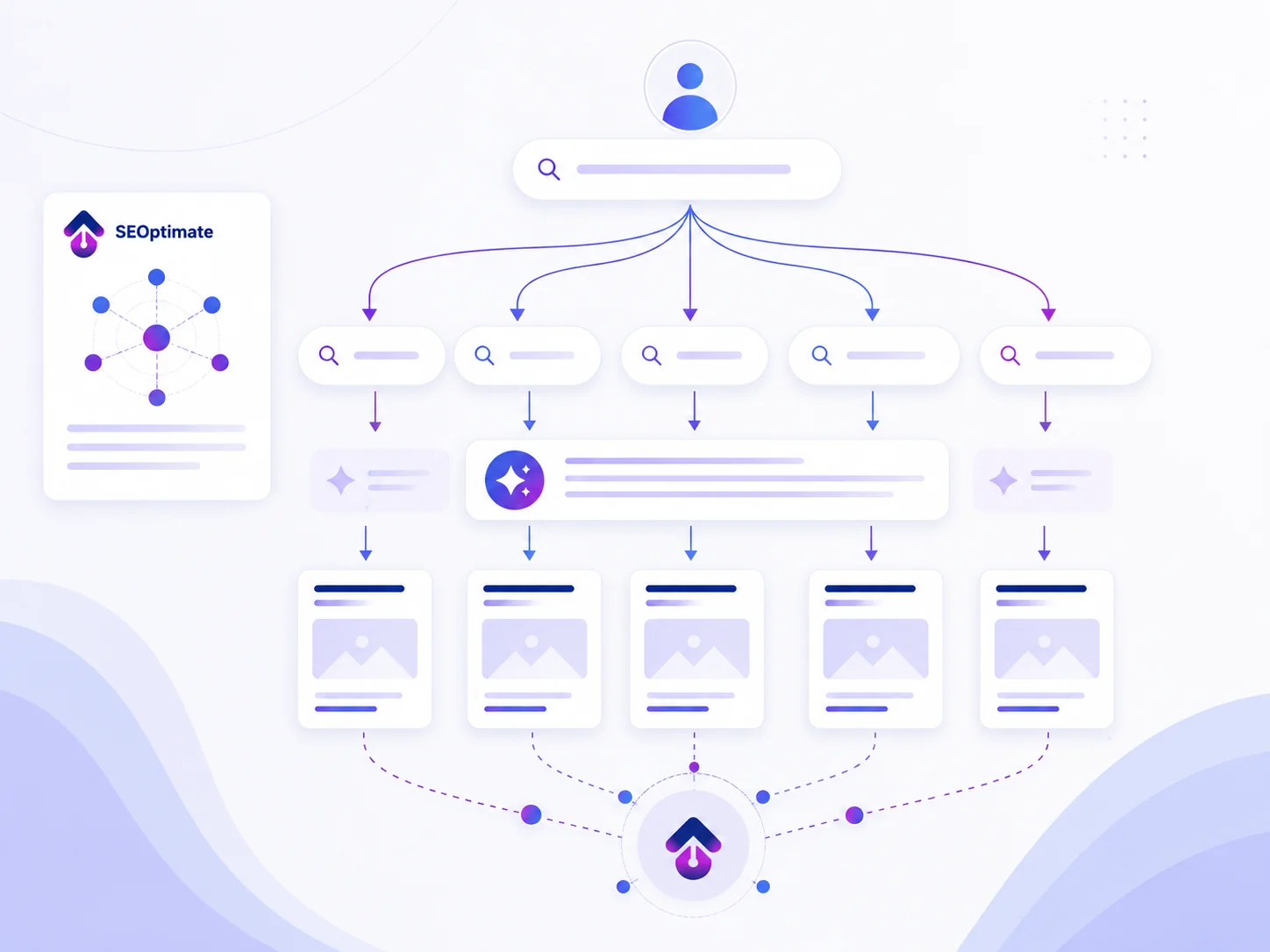
AI Mode and query fan-out make SEO less dependent on single keywords and more dependent on complete topic coverage. Google can interpret one question as a set of related needs. Websites that answer the full intent behind a topic are more likely to stay visible.
What is query fan-out?
Query fan-out describes the way an AI search system can expand one question into multiple related searches or sub-questions. Instead of treating a query as one fixed keyword, the system looks at the broader intent behind it and gathers information from different angles.
For example, a user may ask “what is the best SEO tool for a webshop?” A classic keyword approach might focus only on “SEO tool webshop”. An AI search system may also consider related needs such as product page optimisation, category SEO, Google Search Console data, content generation, pricing and whether an agency is needed.
This means a website can no longer rely on one narrow page to cover a complex topic. The stronger approach is to build a cluster that answers the main question and the surrounding questions.
Why does AI Mode change keyword strategy?
AI Mode encourages longer and more conversational searches. People are more likely to ask complete questions, add context and continue with follow-ups. That makes search intent more complex.
Traditional keyword research still matters but it should not be used in isolation. A list of keywords does not automatically show how topics connect. You need to know which keywords belong to the same intent, which need separate pages and which should support a broader pillar article.
This is where many websites create overlap. They publish five pages around similar keywords without defining the role of each page. The result is often weaker visibility because Google sees several pages competing for the same intent.
How do content clusters help with AI search?
A content cluster groups related pages around one main topic. The pillar page covers the broad subject. Cluster pages go deeper into specific questions. Internal links connect the pages so users and search engines can understand the relationship.
For AI search, this structure is useful because it mirrors the way people ask follow-up questions. A strong cluster can answer the main question and the related questions that come after it. That makes your website more useful as a source.
For example, a cluster around GEO could include a pillar article about what GEO is, a practical guide about AI Overviews, a page about content structure and a page about measuring AI visibility in Search Console. Each page has its own role but they support one broader topic.
How should you avoid keyword cannibalisation?
Before creating a new article, check whether the search intent is already covered. If an existing page answers the same question, improve that page instead of publishing another similar one. New content should add a distinct angle.
Use a simple keyword map. Assign one main intent to each URL. If two pages target the same intent, decide which one should become the main page and which one should support it. Then rewrite titles, headings and internal links so the difference is clear.
Read our guide about building a keyword strategy that drives organic traffic for a practical way to structure this process.
What should you optimise for in a query fan-out world?
Optimise for intent depth. Start with the core question and then identify what someone needs to know before and after that question. Add direct answers, examples, comparisons and next steps. Use internal links to guide readers to related pages.
Also review your headings. Question-based headings often work well because they match how people search and how AI systems break down topics. They make the content easier to scan and easier to interpret.
Use the free SEO tools from SEOptimate to explore keyword ideas but always group those ideas by intent before turning them into pages.
How does SEOptimate support topic clusters?
SEOptimate helps businesses move from random content production to data-driven SEO execution. The platform identifies keyword opportunities, content gaps, overlapping pages and pages that already receive impressions but need improvement.
That matters because AI search rewards websites that are clear, structured and useful across a topic. You do not need an expensive agency to create endless strategy documents. You need a practical system that tells you which content to create, update and connect.
Want to see how your current content structure performs? Book a free demo at seoptimate.com/demo
Query fan-out is the process where an AI search system expands one query into related questions, subtopics and search paths to build a better answer.
Yes. Keyword research still matters but keywords should be grouped by intent and topic rather than treated as isolated targets.
A content cluster is a group of related pages connected around one broader topic, usually with a pillar page and supporting cluster articles.
Assign one main search intent to each URL and update existing pages when the intent is already covered instead of creating duplicate content.
SEOptimate helps identify content gaps, keyword opportunities and overlapping pages so you can build stronger topic clusters based on data.

About the author
Koen Pijnenburg
Founder & CEO, SEOptimate
Koen Pijnenburg is the founder and CEO of SEOptimate. As an entrepreneur with years of experience in e-commerce and online marketing, he helps businesses grow their organic traffic through AI-powered content automation.
LinkedIn →